The Meno Club
Home
>
Women's Health
>
Hair & Hormones
AN EXPERT COLUMN · HAIR & HORMONES
Dermatologist Reveals: This Is How You Fight Hair Breakage At The Source
By Dr. Patricia Sullivan, MD · Seventeen years in practice
How 100,000+ women fixed their hair by stopping with “repair” products
Most weeks I sit across from at least one woman who apologizes for her hair.
She'll call it frizz, or damage, or she'll tell me she's been “lazy” with her masks. And then she describes the same morning I've heard a few hundred times by now.
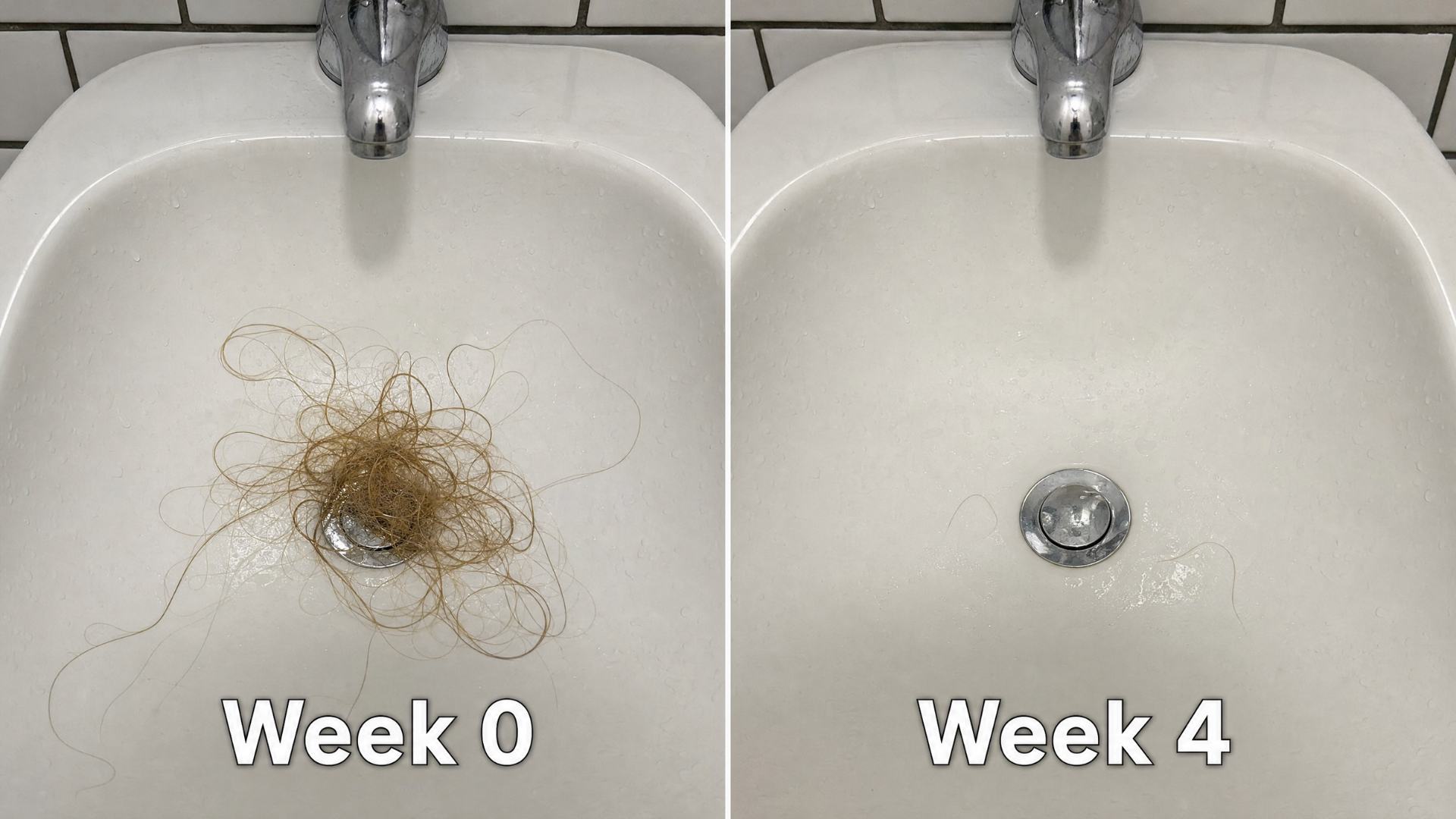
The short hair at her crown that she smooths down before work. The brush that catches where it never used to. The little broken pieces she wipes off the bathroom sink, an inch long, two inches, every single day.
By the time she's in my office, she has done everything right. The bond builder every stylist recommends. A repair mask on Sundays. A silk pillowcase, less heat, air drying when she has the time.
And the breakage keeps coming.
Almost every one of them says the same sentence: I don't understand what I'm doing wrong. Most have already asked someone and been told it's normal for their age, which is true… But also completely useless to her.
Then I ask the question I always ask. “Has anyone ever looked at why your hair is breaking, instead of how you’re trying to repair it?”
Because when you look at one of those broken hairs up close, it tells a very clear story, and it's not something shampoos or hair masks can fix.
Your hair isn't breaking because the hair is damaged. It's breaking because the follicle that built it has shrunk, so the hair it grows today is thinner than the hair that grew out of it 5 years ago. Thin enough that it snaps under its own weight.
That's why nothing you’ve tried has worked. You’ve been treating the wrong end of the hair.
Every New Hair Is Coming In a Little Thinner Than the Last
Somewhere in your early forties, sometimes your late thirties, your estrogen starts to decline. That stretch has a name, perimenopause, and it runs for years before anyone says the word menopause. And it doesn't stop when your periods do, which is why women in their late fifties tell me their hair is still changing.
Most women know estrogen affects mood, sleep, and skin. What rarely comes up at that first doctor's visit is what estrogen was doing for your hair.
It was standing guard.
You've probably read the word DHT by now. What almost nobody gets told is why it left your hair alone for forty years and then didn't.
Estrogen was keeping it off the follicle. Think of it as a shield. You've been making DHT from your own testosterone since you were a teenager, and the whole time, the shield was holding it back.
When estrogen drops, the shield comes down with it.
And DHT, which was always there, starts reaching the follicle. It binds, and the follicle shrinks a little. Then a little more the next time it builds a hair.
We call that miniaturization, which just means every new hair comes in a little finer than the one before it.
Estrogen drops, the shield comes down, and DHT reaches the follicle. From there it's the same thing over and over: each cycle builds a hair a little finer than the last, until one comes out too thin to hold its own weight.
A healthy strand bends. A strand that thin just breaks.
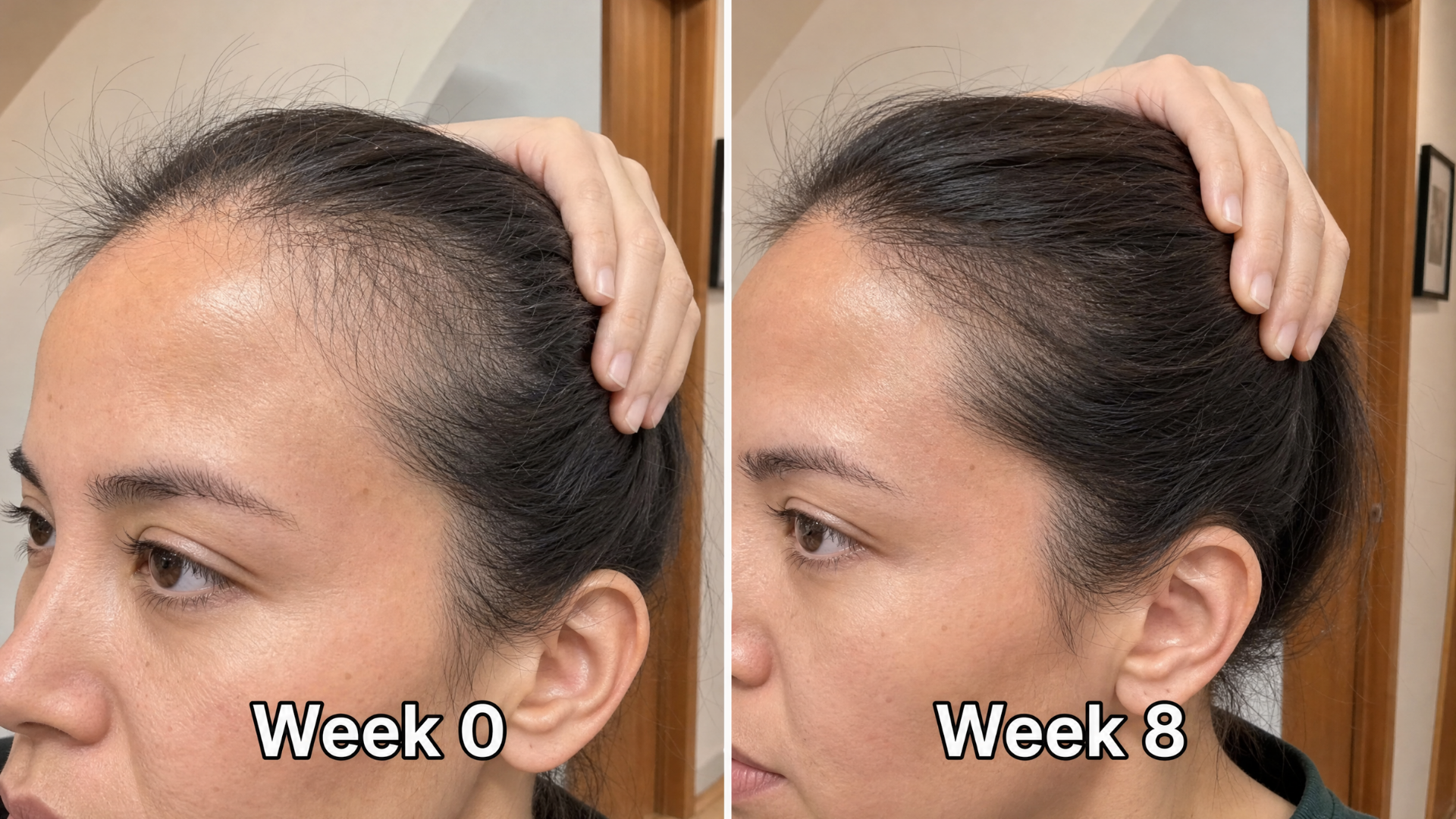
Not every woman finds this on her sink. Some tell me the part looks wider in photographs, or the ponytail feels thinner in her hand than it used to. It's the same thing happening in the same follicle, just further along. Breakage tends to show up first, because it leaves something behind for you to find.
Once you see that, her whole morning turns out to be one problem instead of four.
Fine hair grabs onto itself, so it tangles and knots the way it never used to, and the brush catches. It reflects less light, so it looks dull no matter what she puts on it. And it can't hold its own length, so it snaps and the pieces end up on the sink.
You can see it on a single hair. Pick up one of the broken pieces and look at the tip. That tiny white dot is the break point. Most women assume split end, or heat. It's neither.
Everything on your shelf is aimed at hair you’ve already grown. But your follicles decided how healthy that hair would be, long before it reached your brush.
I Started Testing What My Patients Were Using
A few years ago I started asking my patients to bring it all in.
Not to tell me what they used. The actual bag, on the desk. And I asked one question of every product in it: does anything in here do anything about DHT? I went through ingredient lists for weeks. The answer, over and over, was no.
What I found made me angry, and not because the science wasn't there. It has been sitting in journals for years. Because nobody had bothered to look.
So let me show you what was in those bags. And what should have been.
Your Bond Builder Is Repairing Bonds That Were Never Broken
Start with the bond builders, because that's where almost every woman starts. They're real chemistry. If bleach snapped the bonds inside your strands, they do exactly what the bottle says. That's why you trust them.
But they work on hair that has already left the follicle. A miniaturized strand has no snapped bonds to repair. It's built too fine, and nothing you put on a finished hair changes what it was built with. It's like ironing a shirt that’s two sizes too small.
The Vitamins Are Feeding a Follicle That Isn't Hungry
Then the pile that sits right next to it in the bag. Biotin, collagen, the gummies, the $90-a-month blends. Biotin deficiency is genuinely rare in adult women, which is why "I took it for a year and nothing happened" is the most common sentence I hear about it. Your follicles aren't short on food. They're under pressure from a hormone, and no vitamin changes that.
DID YOU KNOW
A typical hair gummy gives you over 150 times what your body actually needs. The FDA had to issue a warning in 2017, not because it hurts your hair, but because that much biotin distorts blood test results. It changes what your labs say. Not what grows.
The "DHT Blocking" Shampoo Is in the Drain in Three Minutes
This one has the right word right there on the front of the bottle. That's what she's paying for. Look at what it can actually do, though. It's on your scalp for about three minutes and then it's in the drain. Your body makes DHT on the inside, around the clock, and delivers it to the follicle through your blood. Three minutes of lather on the outside doesn't reach any of that.
And the root sprays and fibers in the side pocket aren't trying to fix anything. They're makeup for a hormonal problem.